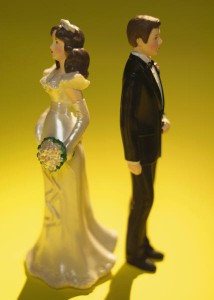
 I don’t believe in marriage. Oh, not in the ‘I don’t believe in Santa Claus and the Easter Bunny’ kind of way, but in the ‘Aw, hell, no!’ kind of way.
As a girl, I never dreamt of a white wedding with bridesmaids in hideous prom dresses and thousands of dollars in debt. I never dressed up my dolls and made them get married. Come to think of it, I really didn’t play with dolls much except to chop off their hair and make them have sex with each other. I certainly didn’t do anything silly like march them down a fictitious aisle and make them profess undying love to each other. I much rather play in the mud or eat snow or read a good book. I taught myself to read at an early age–either three or four.
Still, I grew up assuming I’d get married because it’s what women did, right? I would go to college and get my MRS degree simply because it was expected of me–both college and marriage. Then a few years later, I would birth me some babies because that was the natural order of things. I would get a steady job in my field (psychology) and my life would progress in a timely and predictable fashion.
Funny thing about expectations–they can crumble apart in an instant. In college, I met the love of my life. We were doomed from the start for many reasons, but that deterred me not a whit. While we were together, I realized that I was also attracted to women–physically. I put that aside, however, because I was just beginning to grapple with my gender (female) and race (Taiwanese/Asian-American). The last thing I needed was to deal with homophobia–internal as well as external. Besides, I was with the man I loved–a relationship fraught with problems.
Pretty soon thereafter, I realized that I didn’t want any kids. Again, it was something I assumed would happen because that’s just what we women did. However, the minute I started to examine this assumption, I knew with dead certainty that I didn’t want kids. You’d be surprised by how much hostility I encountered for making this simple statement. That, however, is another entry in and of itself.
I wanted to marry the man I dated in college. I loved him, so we should be married. Yes, my thinking was pretty traditional in those days. However, when I really examined the issue, I realized that I was not so enamored with the idea. This journey was much longer than my realization that children were not for me. First, I decided that if I got married, I wouldn’t change my name. I like my name. I’ve lived with it all my life. I wasn’t gonna change it for nothing.
Then, the ring. I didn’t like the idea of only the woman wearing an engagement ring because it smacked of possession to me. I decided if I ever got married, we would both wear engagement rings or neither of us would. That was more egalitarian. The problem was, marriage is steeped in patriarchal tradition, and I wasn’t sure if I wanted to be a part of it.
In addition, there are privileges that married people get that single folks don’t. In fact, our society is geared towards married people and families in a way that is insidious, enduring, and pervasive. I wasn’t sure I wanted to participate in an institution that successfully marginalizes single people. From tax breaks to cheaper hotel rooms (proportionally) to hospital visitation rights to just the approval that comes from saying one is married, it never ends.
Finally, after realizing that I was bi, I couldn’t get over the fact that I could marry someone I loved if he were a man, but not if she were a woman. I mean, I could marry Sean Hannity tomorrow if we were both single (no matter how repellant he is to me personally) simply because he has a penis, but I couldn’t marry Rachel Maddow if she were single, no matter how much I adore her and her geeky laugh.
So, I took a stance against marriage for the political reasons I named above. That was pretty much all I thought about marriage–until my last serious relationship. It was with a guy (with serious commitment issues) who would periodically asked if I would marry him if he proposed. I would always brush off the question by telling him that once he could tolerate having me in the same city, then we would talk about marriage. Or, I would give him my political reasons for not wanting to get married. Once in a while I would proffer my need for space as the reason I didn’t want to get married. Even his counter of me having a room of my own (I am NOT Virginia Woolf!) didn’t warm me to the idea. That made me wondered if there was something else to my refusal to marry–something other than my political objections.
After thinking about it some more, I had to admit the truth: I didn’t want to get married. I examined the issue from every angle and could not come up with a single reason I wanted to partake in the institution of marriage. I don’t want children; I don’t need to formalize a relationship; I don’t give a shit about anniversaries and things like that. Hell, I’ve never even lived with someone, romantically. I hate sleeping in the same bed as someone else, and I doubly hate being aware of having someone else around me all the time. I don’t even want to live with someone, so the idea of marrying someone is, frankly, an anathema.
So, when I say I don’t believe in marriage, what I really mean is that I don’t want to get married–which makes me doubly pissed-off that queers have decided to make this the cause around which we are all supposed to rally. If they, we, are really interested in the equality of ALL queers, they, we, would have chosen something else–like ENDA (Employment Non-Discrimination Act).
Still, as much as I don’t want to care about marriage, it pisses me off even more when someone takes away my civil rights. Therefore, I will reluctantly make it my issue, but with mixed feelings, because what it comes down to is this: I alone should have the right to decide if I want to be miserable with a woman for the rest of my life rather than a man. Me, deciding what’s moral for MY life. What a radical idea!
Sorry, comments are closed for this post.